Why I created The Attention Experiment
I fell in love with the internet when I was sixteen. I spent the next twenty-five years working inside social media. And then I realised it had hooked me too.
This is the story of how that became The Attention Experiment.
1996
The school computer room
In the mid-nineties, as networked computers were arriving in schools, I used to queue up at lunchtime in the computer room, just to talk to my friends on the other computers. In the same room.
That year, I wrote an article for my school magazine called Surfing the Internet. It ended with a question:
How far will the Internet go? And how long before it not only takes over the business world but the social world as well?
Thirty years later, the government is debating exactly that.
2018 to 2019
Hooked
Around 2018, I woke up to what I call the shadow side of social media. I learned about addictive and persuasive design. I noticed how anxious and overwhelmed my clients were becoming.
And I noticed it in myself. In 2019, I wrote this in my second book:
I am addicted to social media. The itch to pick it up even though I only picked it up a few minutes ago… Coming round to the reality that I'm hunched over a small bright rectangle, noticing I'm lost in an endless scroll, forgetting what I had come on to check, or do. Time lost, energy drained. Cross with myself for doing it again.
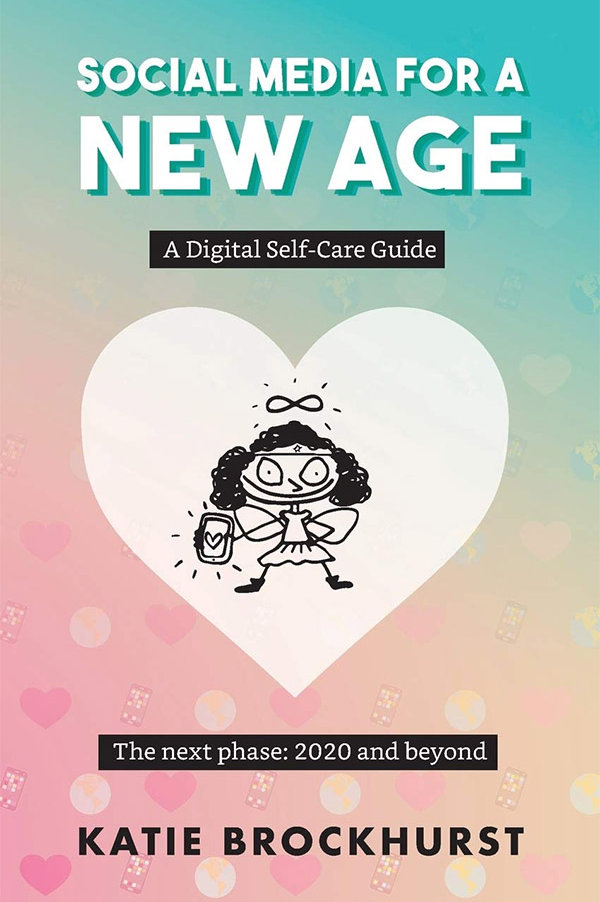
I was burnt out and disillusioned. Years of working over laptops and phones had even left me with chronic pain in my jaw. I needed to understand what was happening to me, and to all of us.
2020
Learning what it does to us
So during lockdown, I trained as one of the first digital wellbeing coaches, with the Consciously Digital Institute, studying what screens do to our brains and bodies.
For years after that, I felt quite out in the wilderness. I'd run digital wellbeing workshops and get smaller numbers than the yoga class next door. It's a hard thing for people to look at, because it's so woven into all our lives.
But I kept studying, and kept connecting the pieces. What is digital wellbeing?
2026
"Katie, you are in a Scroll Loop"
One day, I was sitting outside a café waiting for a friend. At the next table, two women were having the most wonderfully spicy conversation, and I couldn't help overhearing. So I got out my phone, as a kind of shield.
Before long I was scrolling, not looking at anything in particular, a low-level restlessness bubbling up. And then I heard myself say, clearly, almost as if someone else had said it out loud:
"Katie, you are in a Scroll Loop."
I put my phone face down. Looked up. Took a breath. And I was back: in the sunshine, in the moment, smiling at the people walking past.
It wasn't willpower, or a screen time limit, or a rule. It was naming it. And naming what you're doing while you're doing it has a name of its own: metacognition. That's where choice lives. What is a Scroll Loop?
Now
Four words
From everything I have been learning, and through working with my amazing coach Matt Thomas, I then built an attention sequence to help teach this. Four simple words that map what happens to our attention, whatever our age:

Beta participants have been trying it with their families, at work and at school. Their feedback shaped the free app, the seven-day experiment, and everything I now teach.
See how it works
Then I took it into schools, to assemblies, classrooms and staff rooms. I submitted written evidence to Parliament on AI and EdTech. And as AI became part of daily life, the same method became Prompt, Loop, Notice, Choose. What is a Prompt Loop?
Why it's an experiment
I don't want to oversell the sequence. It's new, and digital wellbeing is still a new field. But I've been living it my whole career.
The research behind The Attention Experiment
That's why it's an experiment. You have to try it for yourself for it to work. The Attention Experiment is an independent, evolving project, shaped through real participation, reflection, and what we learn together.
I still Scroll Loop every day. Some days every hour, if I'm honest. But now there's a door, and I'm getting out much quicker.
Why I do this
My business coach once called me poacher turned gamekeeper. I'm not anti-social media, even though it may sometimes seem that way. I'm fiercely pro what social media was supposed to be.
The problem isn't the technology. It's the business model built on top of it. They used neuroscience to hook us. I want to use it to help unhook us.
My sixteen-year-old self believed in something special. It still exists. And now I want to fight for it.