Digital wellbeing at work:phones, focus and AI
Always on and always checking?
Most of us can't do our jobs without technology. But the same devices that help us work are designed to pull our attention away from it, and now AI is changing how we think, write and make decisions too.
I run sessions for teams on phones, focus and AI. This is why, and what we explore.
Success can equal screen time
A few summers ago, work was going brilliantly. I was running the social media for The Common at Glastonbury Festival and managing accounts for bestselling authors, with posts going viral.
And I noticed I was picking up my phone far more. Hopping from app to app. Dipping into clients' accounts "just to check" everything was performing, which my rational brain said was part of doing a good job. But there was an edge to it: chasing the buzz of the results.
My body noticed before I did. Tired eyes, even though I was sleeping well. A tightness in my stomach. Shallow breathing, all at the top of my chest.
One afternoon I thought of something I needed from Amazon. Next thing I knew, I was in Telegram, then Instagram, then something else. Ugh, I'm doing it again!
That's me, a conscious, aware adult who works in this field. It's designed to hook into our minds, our hormones and our attention, so of course it gets all of us to some degree. It's part of why I stopped managing accounts for clients and trained in digital wellbeing.
The busier and more successful we are, the more our work can pull us online. Success can equal screen time.
The always-on culture
We're conditioned to believe we should always be on: earning, doing, replying, scrolling.
I wrote this in my second book, and I still believe it: we keep creating an always-on culture when we contribute to it by always being on it.
If I always reply straight away, people come to expect it. If I send emails at 10pm, others feel they should be checking at 10pm too. And when a leader visibly switches off, everyone else feels they can too.
Urgency feels like stress
So much of our technology runs on urgency. Pings, badges, red dots, "just checking in", read receipts.
How does urgency feel in the body? For a lot of people, urgency feels like stress. And when it's arriving all day, from every direction, our nervous systems rarely get the chance to settle.
What switching does to focus
When I teach in schools, one of the most powerful sessions is simply showing what happens in the brain when you focus on a task without interruption, compared with what happens when you break off to check a message or switch between apps.
It's exactly the same at work. A work laptop is also a gateway to email, messaging, social media, news and AI, all sitting one click away from the thing you sat down to do. Most of us have never been taught what that constant switching costs, or how to protect our focus from it.
AI at work
AI is now part of how many teams work, and it can be really useful. But I've noticed a new pull. Quick prompting can turn into handing over your thinking, until the work no longer really feels like yours. I call it a Prompt Loop.
Early research suggests that relying on AI to do our thinking may weaken skills like critical thinking over time, with 17 to 25-year-olds the most affected. That's your graduate intake. Many employers are noticing that AI gets the work done while junior staff lose the habit of thinking it through. Is AI making us think less?
I'm not saying stop using AI. Just keep asking: is AI supporting our thinking, or replacing it?
What teams can try
Agree reply times. Make it normal not to answer messages the moment they arrive. Decide together what really needs a quick response, and what can wait.
Close up shop. Pick a time when the working day ends, and protect it, especially for messages.
Say when you're offline. Declaring that you're stepping away, rather than just disappearing, helps change the culture for everyone.
Protect focus time. Block time for deep work, with notifications off, and respect other people's.
Make meetings phone-free. Even a phone sitting on the table can change how present people are.
Leaders go first. People copy what they see.
Share a language. Once a team knows the words Scroll Loop and Prompt Loop, people can name the pull, gently and without judgement, for themselves and each other.
For more ideas, see my digital self-care guide.
Sessions for teams
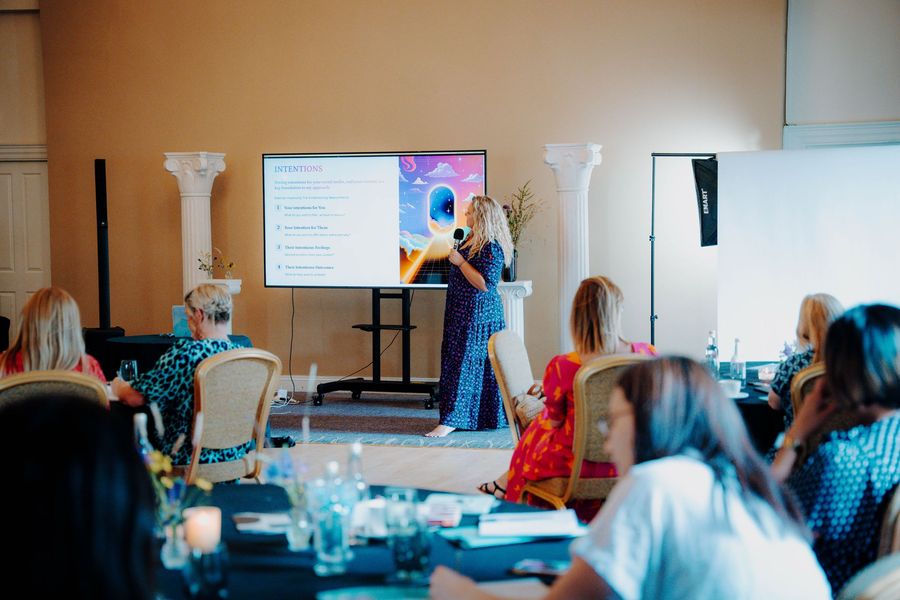
I run sessions for teams, graduate schemes and leaders, from 90 minutes to a full day, online or in the room. We explore how phones and AI pull on attention at work, and practise a simple way to catch it in the moment: Scroll, Loop, Notice, Choose, and Prompt, Loop, Notice, Choose for AI. Everything is built around the week: I run the session, your people run the experiment for seven days, and we look at what happened.
No one wants another screen-time lecture, so sessions are practical, honest and body-based. People leave with a shared language, a few small experiments to try, and the free seven-day experiment to keep going. See how the method works
From £500, for the first organisations to book, in exchange for a short case study. Introductory pricing until March 2027. For half days, full days and organisation packages, get in touch.
Before this week I was unconscious of my relationship with my phone and now I have awareness so I decide about scrolling.
Grounding, inspiring, safe.
Thank you so much! I'm already noticing more.
About me
I'm a qualified digital wellbeing coach with twenty-five years' experience working inside social media, from the music industry to running my own agency. I lead the digital team for The Common at Glastonbury Festival, and my written evidence on AI and EdTech has been published by Parliament. More about me Looking for a speaker for an event or conference? See my speaker page
Questions people ask
What is digital wellbeing at work?
It’s how technology affects people’s health, focus and happiness at work, and what individuals and teams can do to build a healthier relationship with it. What is digital wellbeing?
What does a workplace session include?
We explore how phones and AI are designed to pull on attention, what that does to focus and wellbeing, and practise a simple method to notice the pull and choose what happens next. Sessions are tailored to your team.
Are sessions online or in person?
Both. I run sessions online, or in person with your team.
How can we reduce always-on culture?
Agree shared norms together, like reply times and an end to the working day, and have leaders model them. Small, visible changes help everyone feel they have permission to switch off.
Book a free 30-minute taster for your team.
Or try it yourself first: start with seven days